Showing posts with label Geological time. Show all posts

Monday, 23 February 2026

Trying to imagine the enormity of geological time

 Have you tried 'Counting to one million? - trying to imagine the enormity of geological time'.


This Earthlearningidea is an activity to help young children to understand deep time.

Related activities can be found in our Geological Time category - Visualising deep time.

Monday, 27 October 2025

Working out the geological history from photographs

The new ELI today is 'Some classic Scottish geology revealed; how good are you at establishing a geological history from photographs?'


In this activity pupils are asked to examine photographic evidence to establish a geological history of a small area, and to assess the reliability of their conclusions.

Related activities can be found in our Geological Time category - Stratigraphy and Sequences.

Monday, 30 June 2025

Relative dating of rocks

Our new ELI today is '‘Photo dating’; using photos to simulate the relative dating of the rock record.'

This activity has been devised to demonstrate the principles behind relative dating using zone fossils by substituting photographs, taken over a period of time within the experience of the students.

Related activities can be found in our Geological Time category.

Monday, 23 June 2025

Geological time

We continue our series investigating geological time with '‘Looking so far into the Abyss of Time’; how to visualise the immensity of geological time...with a rope!'.


This ELI is an exercise to demonstrate the extent of geological time-scales and the need for meaningful geological reference points, obtained from fossils and other geological events, recorded in the rock record.

Go to 'Visualising deep time' in our Geological Time category for other related activities.

Monday, 16 June 2025

How do we know the actual age of rocks?

The ELI today continues our theme of geological (deep) time  with 'But how old is it? Investigating radioactive dating of rocks and minerals'.


This activity investigates how radioactive (radiometric) or absolute dating of rocks and minerals works.

Related activities can be found in our Geological Time category - Visualising deep time.

Monday, 9 June 2025

Helping to understand geological time

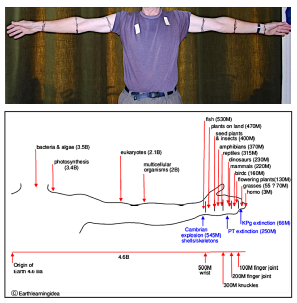
Continuing our theme of geological time, the ELI today is 'The origin of the Earth – at arm’s length: the age of the Earth - with a good stretch of imagination.'


This activity teaches the great length of geological time in a fun way. It could be used to reinforce other methods of helping pupils to understand the concept of “deep time”, e.g. during a quick-fire revision session.

Related activities can be found in our Visualising Deep time, Geological Time category.

Monday, 2 June 2025

For the next few weeks, we will be considering geological time. The ELI today is 'The toilet roll of time; make a geological timeline to take home'.


This activity has been devised to address the common lack of knowledge about geological time. Research has shown that many people have no idea of the great length of geological time nor of the order of the key events during the geological history of the Earth.

Related activities can be found in our Geological Time category, Visualising deep time.

Monday, 30 December 2024

Today we continue our theme of understanding geological time with "James Hutton – or ‘Mr. Rock Cycle’? Thinking towards the rock cycle, the Hutton way".

This activity involves a series of questions and answers that attempt to outline the possible thoughts of James Hutton as he developed his ideas in the context of what we now call the rock cycle.

Related Earthlearningideas can be found in our Geological Time category.

Monday, 16 December 2024

How to visualise the immensity of geological time

 The new ELI today is ‘Looking so far into the Abyss of Time’; how to visualise the immensity of geological time...with a rope!'


This Earthlearningidea is an exercise to demonstrate the extent of geological time-scales and the need for meaningful geological reference points, obtained from fossils and other geological events, recorded in the rock record.

Many related activities can be found in our Geological Time category.

Monday, 15 January 2024

Alligators spotted in London

 
Pupils obtain information and use it to interpret past environments. The activity could be used in science, geography or environmental studies lessons. Writing the story involves a cross-curricular link with the arts.

 Other related activities may be found in 'Visualising deep time' and in Cross-Curricular ELIs.

Monday, 8 January 2024

Imagining the enormity of geological time

The new ELI today is 'Counting to one million? - trying to imagine the enormity of geological time'.

 
This activity helps young children to understood the meaning of one million and from there hundreds and thousands of millions. Related activities can be found in our 'Visualising deep time' category.


Monday, 20 February 2023

What sedimentary rocks can tell us about sea level change

The new ELI today is part 2 of 'Walther’s law of sedimentation – teaching it the Lego TM way: How does a relative fall in sea level affect a vertical sequence of sediments?'

This ELI is a hands-on demonstration of a key principle in sedimentology and stratigraphy, to show how a relative fall in sea level can result in the development of a ‘coarsening-upwards’ sequence.

Click here for other ELIs about stratigraphy and the sequencing of events.

Monday, 21 November 2022

Make your own geological timeline

We continue our theme of geological time with 'The toilet roll of time; make a geological timeline to take home'.


This activity has been devised to address the common lack of knowledge about geological time. Research has shown that many people have no idea of the great length of geological time nor of the order of the key events during the geological history of the Earth.

More activities can be found in the ELI Geological time category.

Monday, 14 November 2022

The age of the Earth - on a volunteer

The new ELI today is all about visualising deep time 'The origin of the Earth – at arm’s length; the age of the Earth – with a good stretch of imagination'.

Visualising deep time is extremely difficult. This activity provides a 'fun' way of teaching the great length of geological time. It could be used to reinforce other methods of helping pupils to understand the concept of 'deep time', e.g. during a quick-fire revision session.

Related activities about the age of the Earth can be found in the Geological time category.

Monday, 25 April 2022

How modern environments may be preserved in a sequence of rocks

Following on from our new ELI about Walther's Law last week, today's ELI is about interpreting environments from a sequence of rocks and comparing the results with modern environments - 'Environmental detective: imagining how the evidence of modern environments could become preserved'.

This activity is an imaginative exercise in thinking about where different environments might occur on a tropical desert coast and how the evidence might become preserved in a sequence of rocks.

You can find other Earthlearningideas related to this is our topics and teaching resources.

Monday, 18 April 2022

How a relative rise in sea level affects a vertical sequence of sediments?

Today's new ELI+ is 'Walther’s law of sedimentation – teaching it the LegoTM way How does a relative rise in sea level affect a vertical sequence of sediments?'

This activity aids an understanding of the effects of relative sea level change on stratigraphy - - an important aspect of sedimentology and stratigraphy.

Related activities can be found in 'Stratigraphy and sequences' on our website.

Monday, 7 June 2021

Relative dating - dating the Earth before radioactive dating

'Dating the Earth – before the discovery of radioactivity; Charles Lyell and Mount Etna, 1828'.


The activity provides an opportunity to use simple mathematics in solving a long-standing geological problem. Students should be made aware that the figures are extremely approximate, and that the activity is designed to show the principle behind Lyell’s approach, rather than providing an accurate value.

Other activities related to finding out the age of the Earth can be found in the Geological Time category on our website.

Monday, 31 May 2021

Dating rocks

The new ELI today is 'But how old is it? Investigating radioactive dating of rocks and minerals'

This activity investigates how radioactive (radiometric) or absolute dating of rocks and minerals works. It is suggested that pupils work from the video.

Other activities about dating rocks and the Earth can be found in our 'Geological Time' category.
 

Monday, 26 April 2021

What colour was the world in the past?

'What colour was the world in the past? Using rock evidence and ‘the present is the key to the past’ to colour the geological world'.

Earth’s surface colours today are produced by the same processes that operated in the geological past. Since the features that made up past geological landscapes were coloured in the same ways as today, many of these landscapes must have had the same combination of colours as Earth’s surface today.

This activity is a discussion, using the colours of unweathered surface rocks and ‘the present is the key to the past’ to give a coloured picture of past geological worlds.

Lots more activities can be fund on our website.

Monday, 29 March 2021

Geological time gaps - unconformities

'Filling the gap – picturing the unconformity ‘abyss of time’? Working out what happened during unconformity time gaps'


This activity gives pupils a method to help them to visualise the enormous time-spans between the upper and lower layers of unconformities.

Many more activities about Geological time, or 'deep time' can be found on our website.