Tuesday, 1 March 2016

Record number of activity downloads in February

We have just completed our monthly analysis of Earthlearningidea and are very pleased to announce another record. There were 63,176 downloads of our activities in all our translated languages across the world in February.

Further details may be found on the ELI in the world page of the website.
Many thanks to our hundreds of supporters. Please keep the ideas coming!

Monday, 29 February 2016

How does sediment move in water?

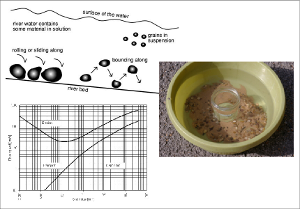
New ELI today: 'Rolling, hopping, floating and invisibly moving along; investigating how sediment is transported by water'.


After completing the activity, pupils can:
• observe that under very low flow, some grains become suspended;
• realise that with faster flow some sand grains bounce along while others are carried round and round by the flow;
• appreciate that a much faster flow is required to roll or slide the gravel grains along the bottom of the bowl.
• observe that the salt dissolved and went into solution.
Many more activities about the erosion, transportation and deposition of sediment can be found on the ELI website.

Monday, 22 February 2016

Sole marks - evidence about past environments

What evidence does the bottom of a sedimentary bed give you about the palaeoenvironment? To find out try the ELI 'Sedimentary structures - sole marks'


This activity is part of a series on sedimentary structures and the ways in which
they can be used to interpret past conditions. This ELI is based on diagrams and
photographs of sole marks.
The rest of the series can be found on our website in the index under 'Sedimentary structures':-

Monday, 15 February 2016

The questions to ask about sedimentary grains

Today's new Earthlearningidea continues our field work series with 'Questions to ask at any rock face 5: sedimentary grains'. 

Ask your pupils to answer the following questions when they are looking at any natural rock face - in a cliff, a quarry or a building.
- How big is the largest grain you can see? (estimate the length in mm or cm)
- When the sedimentary grains were being laid down, how might they have been moved here – by wind, water, ice or gravity?
- Was this deposit laid down in low, medium or high energy conditions? (More energy is needed to move and deposit large grains than smaller ones)
- Does the rock have several sizes of grains or just one size? (The further grains are carried, the more they tend to be sorted out into coarse, medium and fine sizes)
- Have these grains travelled far? (Grains with sharp corners have not moved far but rounded pebbles will have travelled a long way)
- What does the grain evidence tell you about this sedimentary deposit?
Lots more ideas for teaching about sedimentary rocks or fieldwork can be found on the website.

Monday, 8 February 2016

Rock game - characteristics of rock types

A game your pupils will enjoy is 'Rockery 1'. 

In this activity pupils model the different characteristics of rocks; the game helps children to remember the fundamental differences between rock types and is a lot of fun.
Many more activities about rocks and rock groups can be found on the ELI website.

Monday, 1 February 2016

Where does Offshore Oil come from?

The new Earthlearningidea published today aims to dispel misconceptions about the source of oil - 'Where does offshore oil come from?'

This cartoon block diagram of a coastal area shows many of the misconceptions shown by educational research about where people think oil from offshore areas is actually found. In this activity pupils are asked to tick on the table provided whether the source shown on the diagram is right, partly right or wrong. A discussion about their results then follows. They could also try one of the related activities about oil and gas listed on the website.

Monday, 25 January 2016

Coarse to fine sediment in one sedimentary bed? Graded bedding

Have you tried the ELI 'Graded bedding'? It is one of a series of activities explaining sedimentary structures. 'Make your own graded bed - one depositional event, but with coarse to fine sediment'.
This activity can be used in any lesson dealing with the origin of sediments and the interpretation of past environments.
Lots more good ideas for ways to teach about sedimentary structures can be found on our website, either by using the search facility or the alphabetical index.