The image shows the Milky Way taken from PhotopicSkySurvey. You can zoom in and out of the image, look around and superimpose names.
Have you tried any of our ELI Earth in Space activities?
Craters on the Moon
Playground planets
Why does the Sun disappear?
Have you got some good ideas for some more activities in this category? Please send them to us if you have either via the 'comments' on this post or by email.
Monday, 16 May 2011
Monday, 9 May 2011
Geological mapwork - third in the series
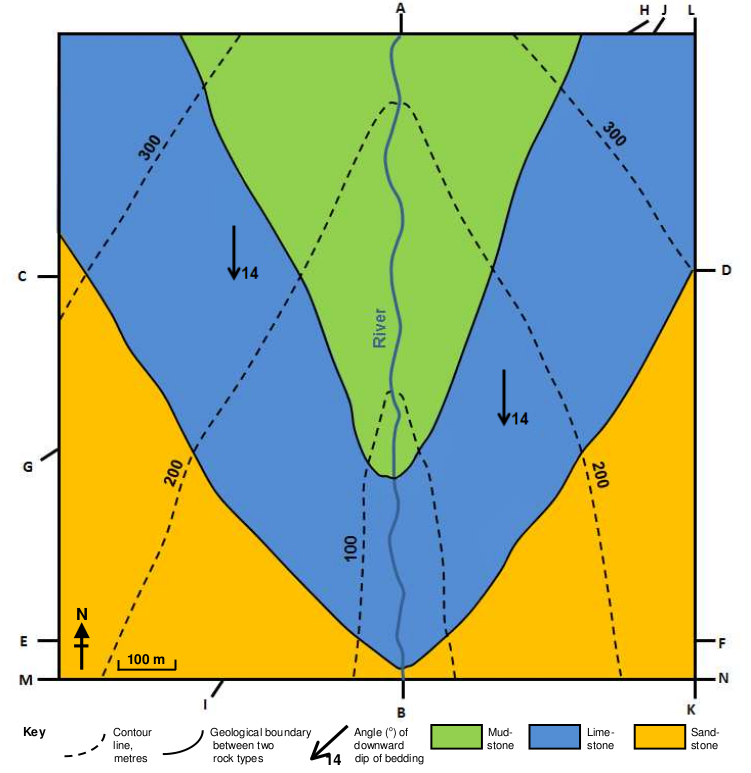
Today, we have published our third Geological Mapwork from scratch activity. This one investigates a valley with dipping geology. Pupils will be able to draw their own cross sections and 3D models. They are shown a photograph of a straight valley and are then given a simple geological map of such a landform, with beds dipping towards the south. They are also encouraged to use the British Geological Survey's OpenGeoscience maps - instructions for doing this are given.
The drawing of these topographical and geological cross sections involves spatial thinking skills. The more complex the cross sections become, the more spatial interpretation is needed, including interpolation and extrapolation skills.
This latest activity is one of many that can be found on our website.
Monday, 2 May 2011
Following last week's glacial/periglacial ELI
On our current glacial/periglacial theme, have you tried 'Grinding and gouging: how moving ice can grind away rocks'? After trying this activity, pupils will be able to
• explain that ice alone will not scratch rock;
• demonstrate that ice carrying sediment will scratch rock;
• realise that ice will scrape any soil and weathered, loose material from the surface of the underlying rock;
• work out the possible direction of ice movement;
• show that other evidence is needed to determine the actual direction of ice movement;
• explain how a valley glacier could erode a deep, U- shaped valley, given enough time.
This is one of many Earth-related teaching ideas in the Earth energy category on our website.
Monday, 25 April 2011
New ELI - Glacial and periglacial landscapes
Our latest Earth Learning Idea is 'Evidence from the deep freeze - under or near the ice sheets'. Pupils are given photographs of glacial and periglacial landscapes and are encouraged to extract the evidence for former environments. When the activity is complete, the pupils can describe landscape features formed as a direct result of the action of moving ice and contrast these with landscapes produced under periglacial conditions.
This is another activity to add to our growing number in the Earth processes or Earth energy category.
Visit our website for lots more hands-on Earth-related activities.
This is another activity to add to our growing number in the Earth processes or Earth energy category.
Visit our website for lots more hands-on Earth-related activities.
Monday, 18 April 2011
Evolution of the atmosphere - more
This video clip is mentioned as a useful link from last week's ELI activity. 'Earth's atmosphere - step by step evolution'.
All comments and suggestions about this activity will be gratefully received.
Monday, 11 April 2011
New ELI - Evolution of Earth's atmosphere
The latest Earth Learning Idea is 'Earth's atmosphere - step by step evolution'. This activity uses a physical model to show the development of our current atmosphere. Pupils are shown the pie chart above which shows the composition of our atmosphere today. They are then asked to model with coloured balls or counters the composition of the primeval atmosphere, details of which are provided. They then consider what happened to the water vapour, carbon dioxide and sulfur oxides. How did oxygen appear in the atmosphere?
Related activities in the category 'Earth as a system' can be found on our website.
Monday, 4 April 2011
Rock cycle through the window
Have you tried the ELI - 'Rock cycle through the window'?
Pupils are asked to consider each of the major rock cycle processes in turn and decide whether or not evidence for these can be seen through the window – if so, what evidence? Of course, this activity can be carried out outside the window too. Surface rock cycle processes affect the whole surface environment; they are active for much of
the time and can be seen in action. Deep rock cycle processes cannot be seen in action – they have to be inferred from the characteristics of their products. By looking for the evidence, pupils understand that these are not theoretical processes, but they are real and happening all around them all the time.
This is one of many freely downloadable Earth Learning Idea activies. Try our search engine to find a particular topic. Please let us know if it is not there!
Subscribe to:
Posts (Atom)